Yerba mate has been the everyday drink of Argentina, Uruguay, Paraguay and southern Brazil for four centuries. People do not drink it for what it promises: they drink it because it is part of the day. Here is what it is, how it is drunk, and where it is and is not like coffee.
What yerba mate is
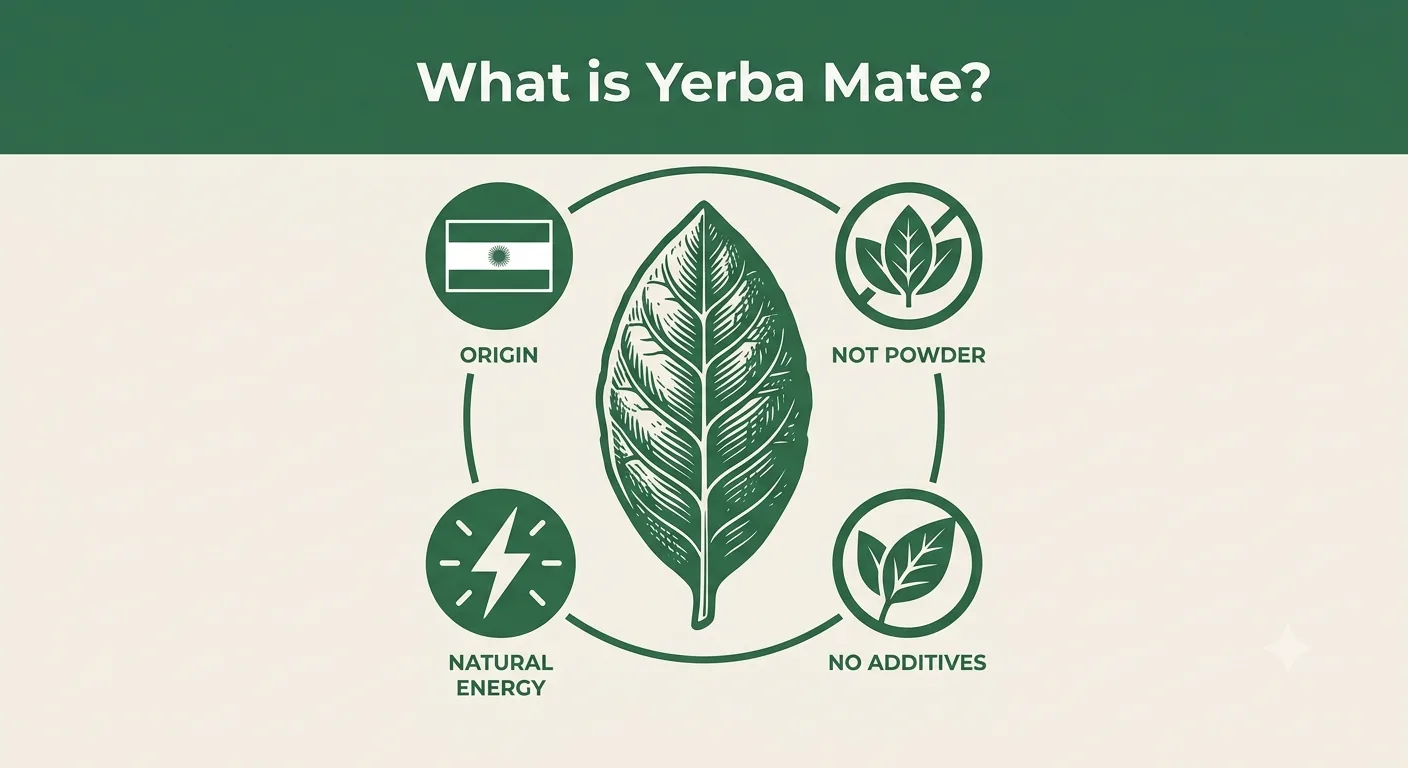
It is the leaf of Ilex paraguariensis, a tree from the South American subtropics. The leaf is dried, milled and brewed in hot water. It carries caffeine, like tea and coffee, which is why it is a daytime drink.
What really separates yerba from other infusions is not a property, it is a habit: it is made in quantity, refilled and shared.
A drink with a ritual
Mate is brewed in a gourd, drunk through a bombilla and topped up with hot water, stopping short of the boil. One gourd lasts as long as the conversation does. The same bombilla goes from hand to hand, and whoever pours serves everyone else before themselves. It is not a metaphor for anything: it is literally how it is drunk.
That habit is what crossed the Atlantic with the can. The format changes, the moment does not.
How it fits into your day
Mid-morning, between two things. After lunch, when another coffee is not what you want. Mid-afternoon, with whoever you are with. In South America mate is the excuse to sit down for twenty minutes, and that is the part people miss when they move away.
In a can the gesture is shorter and it is the same one: you open it, you drink it cold and you pass it round the same way. It fits in a bag, needs no flask and asks for no preparation. For someone who brews at home it does not replace the morning gourd, it keeps it company for the rest of the day.
And there is one moment the can handles better than the gourd: when you are not at home. On the train, at the office, on a terrace, with no hot water within reach.
Mate and coffee, side by side
They are two different drinks that occupy a similar place in a routine. Coffee is short, intense and bitter in a very particular way. Mate is longer and greener, with a bitterness closer to green tea, and in a can it arrives cold and lightly sparkling.
Choosing one over the other is a matter of taste and of the moment. Plenty of people drink both, and the morning coffee is still the morning coffee.
What is in a We Mate can
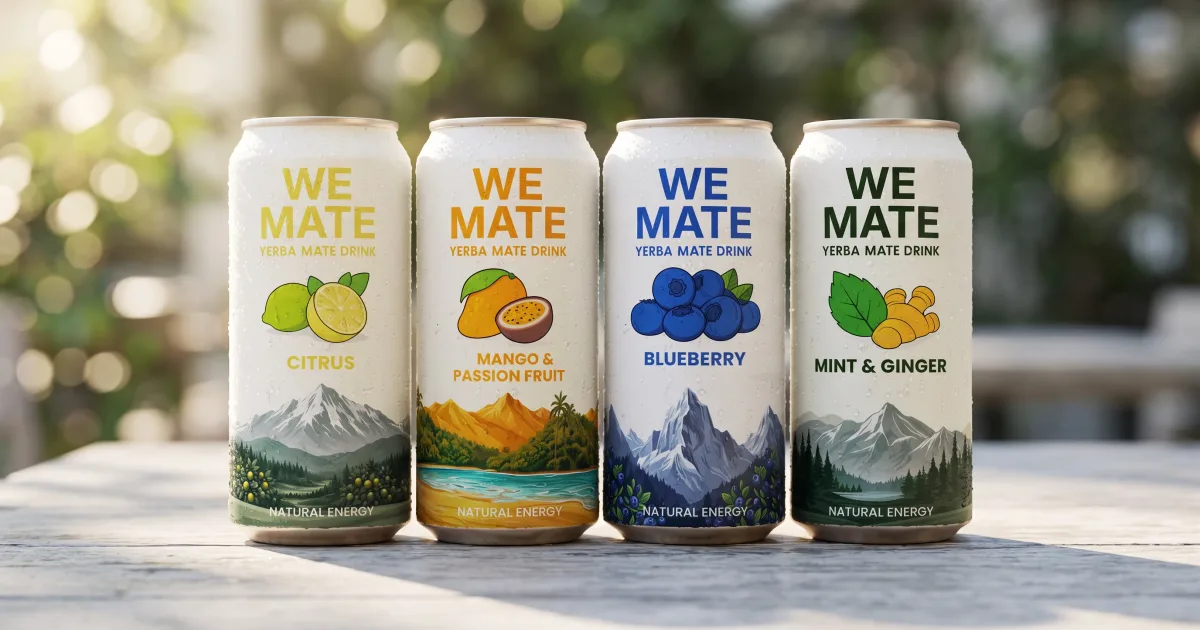
Whole leaf brewed, not powder extract, in a 330 ml can. All four flavours carry 1.25% brewed yerba mate leaf, natural flavouring and a little carbonation.
Citrus and Mint & Ginger have 0 g of sugars per 100 ml: they are sweetened with stevia, which is steviol glycosides and is not an artificial sweetener. Mango & Passion Fruit and Blueberry have 4.1 g per 100 ml, which come from brown sugar and from the fruit juice.
The detail of each flavour is in the four We Mate flavours, and where to get it, in yerba mate in Spain.
What to keep in mind
Mate carries caffeine, so it counts towards your daily total alongside coffee and tea. If you are pregnant, breastfeeding or do not get on well with caffeine, that is the thing to look at. Where the caffeine in the can comes from, and why we do not give a figure yet, is in the caffeine in yerba mate.
FAQ
What does yerba mate taste like? Like a green infusion, with a bitterness close to green tea. In the flavoured cans that base is still there: the fruit joins it, it does not cover it.
When is it drunk? During the day. In South America, in the morning and mid-afternoon, stretched out for as long as the round lasts. In a can, whenever you want something cold that is not a soft drink.
Does it contain sugar? It depends on the flavour. Citrus and Mint & Ginger have 0 g of sugars per 100 ml. Mango & Passion Fruit and Blueberry have 4.1 g per 100 ml.
Do I need a gourd and a bombilla? For loose leaf, yes, and that is part of the point. For the can, nothing: it comes brewed and cold, with the leaf taken out.